A family tree is more than names connected by lines. Places, marriages, photographs and sources tend to accumulate in separate files. Swarm brings them into a native Mac workspace while keeping the tree in a folder you own, rather than behind an online account.
This introduction is based on the v3.5.7 documentation, release assets and source structure, not hands-on testing. It covers samoilev’s genealogy app, not another project called Swarm. Features on the development branch should not be assumed to ship in the current download.
See the tree—and the relationship between two people
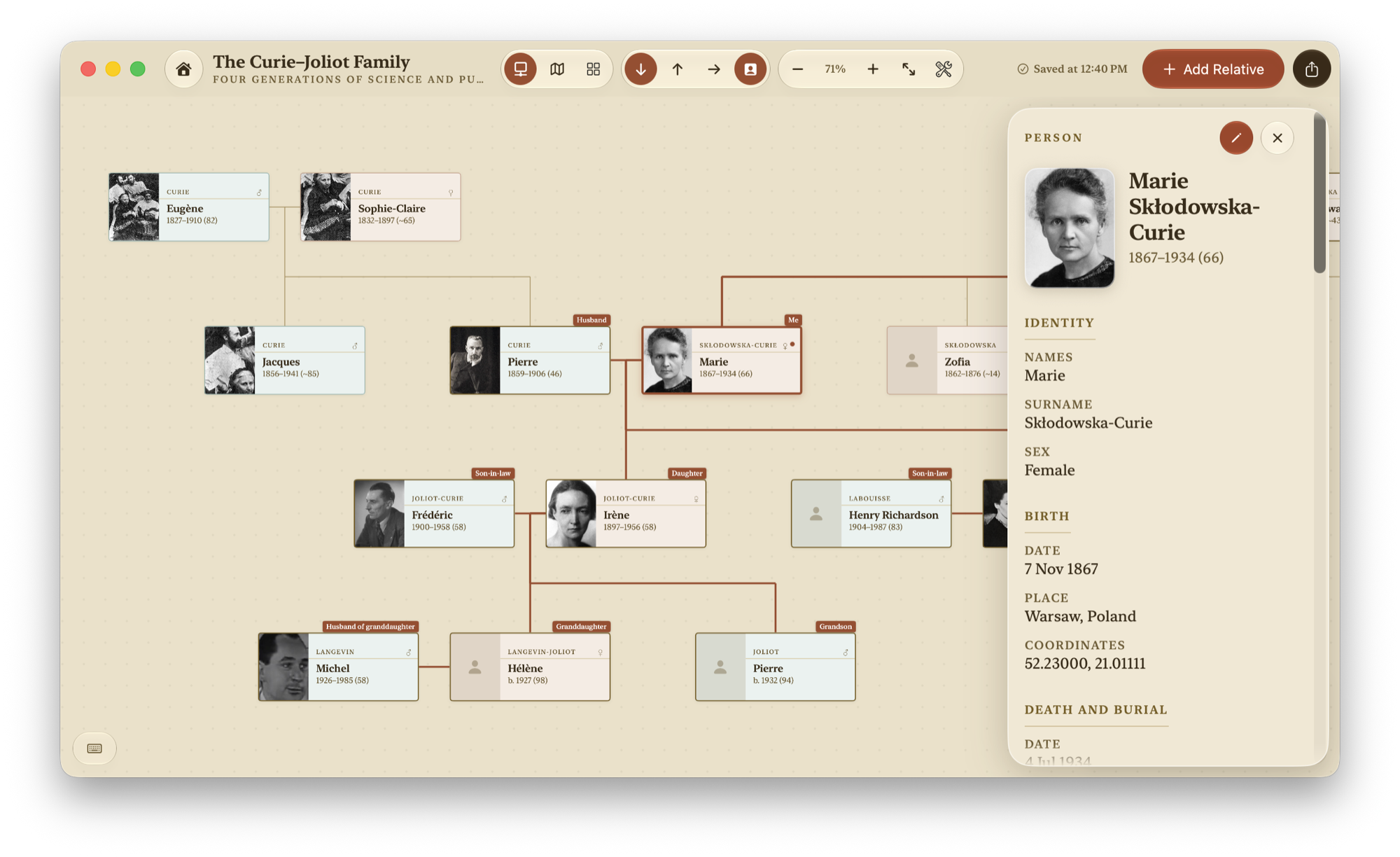
Swarm combines a family-tree diagram, an ancestor fan chart and maps of birth, death and burial places. Photos and attachments belong to individual people. People, timeline, places, sources and citation workspaces provide ways to navigate a growing collection without doing everything on one enormous canvas.
Its English and Russian kinship naming goes beyond direct ancestors: it covers half siblings, cousins across generations and in-laws. You can ask how any two people are related. The interface itself is available in English and Russian; this is not a claim of Chinese interface or kinship support.
GEDCOM keeps the exit door open
The format documented for v3.5.7 is GEDCOM 5.5.1. The project describes exchange with tools including Ancestry, Gramps and MyHeritage, preserving unmodeled event notes, source records and custom tags through edits. A verbatim copy of the imported file is retained as original-import.ged. Keep your own original backup and check relationships and attachments in a test copy before migrating a real collection.
When merging another tree, Swarm identifies exact matches and suggests likely ones. The documented process backs up first and rolls back on failure. PDF export includes a diagram followed by individual cards with photos and attachments, for the entire tree or selected people. Archive export gathers the tree and media into a folder with per-file checksums.
Local-first—with a specific maps exception
Trees live under ~/Library/Application Support/Swarm/, with one folder per tree. The project describes verified saves, the last 50 revisions and 30-day retention of deleted items. Those recovery features are useful, but they do not replace an independent backup on another disk or storage system.
Swarm requires no account and offers no hosted family-tree service, telemetry or AI. Place searches use a bundled GeoNames index. Optional Apple Maps does make network requests, however, and Apple may receive the region being viewed. Select Offline Map in Settings to avoid that connection. Local family-tree storage should not be confused with zero network activity under every setting.
Installation: use the official DMG
No official App Store listing for this project was found at the time of checking. Download the Swarm 3.5.7 DMG or read the release notes. The universal binary supports Apple silicon and Intel Macs running macOS 15 or later. The Liquid Glass appearance requires macOS 26 or later.
Open the DMG and drag Swarm into Applications. This release is not Developer ID signed or notarized. Only after confirming the official source and accepting that limitation, try opening it once, then use System Settings → Privacy & Security → Open Anyway. Leave the Mac’s other security protections enabled.
For an integrity check, download the SHA-256 file beside the DMG and run the following command from that directory. Matching a publisher’s checksum verifies consistency with that download, not Apple notarization or an independent security audit.
shasum -a 256 -c Swarm-3.5.7.dmg.sha256Start with the Curie example
You do not need to begin with private family records. Download the official Curie family example ZIP, unpack it, choose English in Swarm and use Import GEDCOM to select the entire curie-joliot folder—not just its .ged file. Folder import brings the portraits and attachments along.
The official walkthrough notes two country names without coordinates in the preview. Review the warnings and select Continue with these warnings before importing. Swarm imports a separate copy, leaving the downloaded example unchanged. Select Marie Curie, explore the fan chart and export a PDF before planning your own collection.
Who it is for—and what it does not provide
Swarm suits someone who wants a portable family tree they can locate in Finder and is comfortable with an English or Russian interface. It is not a historical-record search service: there is no online records database, DNA matching or hosted tree sync. Use another tool for those needs. For public bug reports, reproduce problems with the sample trees instead of attaching a real family GEDCOM.
License and project links
The source is licensed under GNU GPL v3.0. GeoNames data is CC BY 4.0 and Natural Earth map data is public domain; see the third-party notices. The project excludes the Swarm name and icon from the GPL grant and asks redistributed forks to use a different name and icon. For ordinary use, the official release is the starting point—no Swift development environment needed.
Project facts
- License
- GPL-3.0
- Platform
- macOS 15+; Apple silicon / Intel; Liquid Glass on macOS 26+
- Written in
- Swift / SwiftUI
- Version reviewed
- v3.5.7 (checked 2026-09-22)
- Repository
- github.com/samoilev/swarm
Install
open https://github.com/samoilev/swarm/releases/download/v3.5.7/Swarm-3.5.7.dmgDemo
License summary
Source code is GPL-3.0. Place and map datasets have separate terms; the Swarm name and icon are excluded from the GPL grant.